
If you’ve been in an auto accident anywhere in Hampton Roads, knowing what to do in the hours and days afterward can be confusing. Getting properly evaluated and treated is important, especially if you begin experiencing neck pain, headaches, or back pain. You may have already been to the ER or an urgent care and were told nothing serious is wrong, even though the pain has stuck around in the days or weeks since.
Precision Spinal Care is equipped to evaluate and treat car accident injuries that standard medical exams and routine imaging often miss. Few clinics in the region bring together what acute auto injury patients need in one place. We provide advanced biomechanical testing, orthopedic and neurological evaluations, on-site upper cervical chiropractic, rehabilitation therapy, and massage therapy, with a physician fellowship-trained in spinal trauma who can refer directly to the right medical specialist or order medical imaging with trauma-specific protocols when the injury calls for it. Dr. Packer has served injured patients across Chesapeake, Virginia Beach, Norfolk, Suffolk, Portsmouth, and the greater Hampton Roads area since 2002.
You do not need a referral to be seen. You can schedule an evaluation directly, without a referral from an attorney, a primary care doctor, or your insurance company.
Common Auto Accident Injuries We Evaluate
Collisions, even at lower speeds, transfer force into the neck and spine faster than the muscles can brace for it. The injuries we most commonly evaluate after a motor vehicle accident include:
- Whiplash from the rapid back-and-forth motion of the head and neck
- Neck and back sprains and strains, the stretched or torn muscles and soft tissue that cause much of the early pain
- Spinal ligament tears and instability, where the connective tissue that holds the vertebrae in position is damaged and the joint is left loose
- Bulging and herniated discs in the neck and back
- Pinched nerves, which we screen for during the exam and, when present, direct to the right care
- Numbness or tingling in the arms or shoulders, a common sign that a nerve in the neck is involved
- Headaches after a crash, often coming from the injured joints and ligaments of the upper neck
- Dizziness and vertigo following the impact
Some of these resolve with conservative care. Some are more serious and need to be identified early so they can be treated or referred appropriately. The point of the evaluation is to tell the difference rather than assume.
Why a Car Accident Injury Needs a Different Kind of Evaluation
Emergency rooms and urgent care centers are built to rule out the injuries that need immediate attention: fractures, internal bleeding, spinal cord injuries, and traumatic brain injury. Those injuries are critical to catch, but they are the minority of what people actually sustain in a collision.
The neck is a clear example. In an analysis of national hospital data on crash-related cervical spine injuries, the serious structural ones (fractures, disk injuries, spinal cord injuries, and dislocations) together made up under 5% of cases, while injuries to the ligaments and soft tissue accounted for more than 95% of injuries.
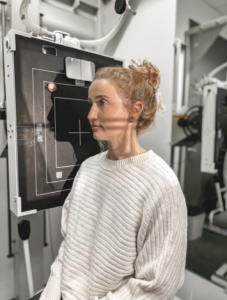
Those injuries are easy to miss, for two reasons. First, they often don’t hurt until a day or more after the crash, once the adrenaline wears off, so a clean ER visit doesn’t always rule one out. Second, they don’t show up well on standard imaging. A routine X-ray or MRI is a still picture, and much of the damage is in how the spine moves. The American Medical Association (AMA) Guides recognize only one test for detecting spinal ligament instability: flexion-extension stress radiography, which measures the spine in motion.
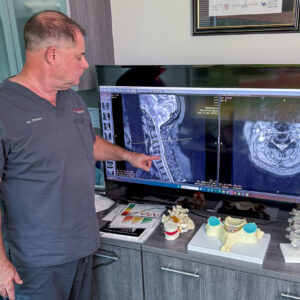
Even when an MRI is the right call, the protocol matters. A routine scan often uses image slices too thick to capture the subtler spine injuries a collision causes, so real findings can get lost between the slices. When imaging is warranted, Dr. Packer custom-orders a thin-slice protocol through the clinic’s close relationship with Chesapeake Regional’s MRI-CT Diagnostics. The finer detail catches smaller injuries a standard scan misses and helps separate the injuries the accident caused from pre-existing degenerative conditions, which is what ties the injury to the collision rather than to ordinary aging.
Why These Injuries Shouldn’t Be Left Alone
These injuries don’t always heal on their own. If you were told you “just have a sprain” that will heal in a few weeks, that can be true for a mild one. But a sprain is a stretched or torn ligament, and not all of them are minor.
A mild sprain often settles with basic care. A more serious one, where the ligament is partly or fully torn, can heal loose instead of going back to full strength. By some estimates, around 1 in 4 people with a whiplash neck injury still have pain a year later.
When a ligament heals loose, the bones it used to hold steady move more than they should. That extra movement wears on the small joints of the neck, which can become a source of ongoing pain. Those same injured joints and ligaments can also send pain up into the head, a pattern called cervicogenic headache. Among people who get headaches after a whiplash injury, the neck is the source in a large share of cases, by some estimates around half.
How Precision Spinal Care Is Built for Auto Accident Injuries
Care after an accident is often scattered: one office for testing, another for therapy, another for follow-up, with no one holding the whole picture. Precision Spinal Care is set up to be your starting point, because the clinical side of your recovery runs through one place. The injury is documented with objective testing, treated without surgery or drugs, and sent to a medical specialist if it needs care we don’t provide. Starting here means it stays one coordinated record of your injury and recovery, which matters both for your treatment and for your case.
How We Document the Injury Objectively
A focused spine and biomechanical evaluation looks specifically for the soft tissue, ligament, and joint injuries a standard exam misses, and documents them objectively rather than relying on a description of how you feel. “My neck hurts” is a symptom, and a symptom is subjective. Objective testing is different. It produces a result that stands on its own, no matter how a patient describes their pain. We perform several objective studies in-house when the clinical picture calls for them:
- Flexion-extension X-ray analysis (AOMSI). These are X-rays taken while you bend your neck forward and back, so we can see how the individual bones of the spine move in relation to each other. Too much movement between two bones points to ligament damage. Under the AMA Guides to the Evaluation of Permanent Impairment (5th Edition), translation at or above 3.5 mm, or angular motion beyond the published threshold, supports a finding of permanent impairment. This is a measurement taken from your own films, not an opinion about how much you hurt.
- DynaROM with surface EMG. This is a spinal range-of-motion test the AMA Guides (5th Edition) recognize. It records your muscle activity and your movement at the same time. You can still move fairly normally while your muscles tense up to protect a sore area, and measuring both shows that guarding in objective terms instead of relying on how you describe it.
- Orthopedic and neurological testing. Dr. Packer performs objective orthopedic tests and standard neurological exams, structured assessments that establish a measurable baseline and can be tracked over the course of care.
- Specialized MRI imaging when indicated. When the exam findings call for it, Dr. Packer orders MRI studies, including the thin-slice protocol described above, and he’s credentialed to interpret them and act on the findings.
Full-Service Conservative Care Under One Roof
Your treatment is matched to your findings rather than run as a fixed protocol, and the hands-on care is delivered in our Chesapeake office.
Upper Cervical (NUCCA) Chiropractic
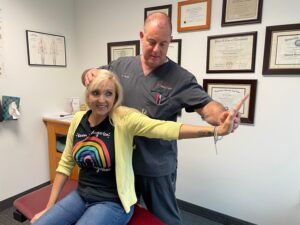
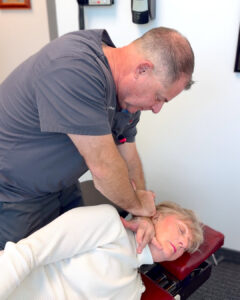
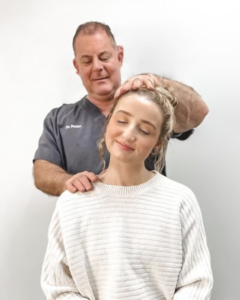
Forceful, twisting adjustments can aggravate an already-traumatized area. NUCCA is a specialized form of chiropractic care that involves no twisting, no rotational force, and no cracking or popping, and Dr. Packer is the only NUCCA board-certified chiropractor in Southeastern Virginia. NUCCA spinal corrections are calculated from precision X-rays and delivered with light, sustained pressure, which makes them well suited to patients recovering from impact injuries.
Rehab Therapy
Most accident patients need active rehabilitation to rebuild the strength and range of motion an injury takes away. Our rehabilitation assistant works directly with patients through that process, and the rehab is adjusted as you progress rather than run as a fixed routine.
Massage Therapy
Our licensed massage therapist on staff provides soft-tissue treatment that is integrated into your care plan, used to address the muscle tension and guarding that often accompany a spine injury.
Referrals to Medical Specialists
Not every injury is something chiropractic care should treat, and Dr. Packer is trained to recognize when a case needs a medical specialist and which one to send you to. Some patients need a neurologist, an orthopedic surgeon, a neurosurgeon, pain management, or their primary care physician. His fellowship training in spinal trauma included clinical rotations and research alongside all these specialties. Knowing where to go for treatment after an accident is one of the most confusing parts of the whole process, so starting here, you find out what is actually wrong and what kind of care or doctor is right for you.
If your evaluation points toward care we don’t provide, Dr. Packer will refer you directly to the appropriate specialist based on the exam findings. We have built strong relationships across the local medical community over more than two decades in Hampton Roads, so we can often help you get an appointment with the right specialist rather than leaving you to find one on your own. The goal is for you to get to the right kind of care, not to keep you in our office.
Why Chesapeake Patients Choose Dr. Packer After an Accident
Two credentials set Dr. David Packer apart for treating auto accident injury cases among Hampton Roads providers. He is fellowship-trained in spinal biomechanics and trauma through the National Spine Management Group post-doctoral division, recognized through the University at Buffalo Jacobs School of Medicine. The fellowship trained Dr. Packer on four things that matter directly to an injury case:
- Advanced spinal imaging
- Spinal biomechanics
- Injury documentation
- Coordinating care across other specialties
His second distinguishing credential is NUCCA board certification, which no other chiropractor in Hampton Roads holds. Many patients seek out NUCCA after an auto accident because of how gentle the care is and the precision of the adjustment. NUCCA is particularly well suited for treating automobile injuries because of its focus on treating the upper cervical spine, which absorbs much of the force in a whiplash injury and affects the balance of the entire spine.

In addition, he also received the following credentials for handling personal injury and trauma cases:
- Trauma Qualified and Interprofessional Hospital Qualified through Cleveland University–Kansas City.
- Post-graduate training in the areas an injury case turns on:
- MRI spine interpretation
- Spinal biomechanical engineering and digital AOMSI analysis
- Orthopedic and neurological testing
- Crash dynamics
- Impairment rating under the AMA Guides
- Training in forensic documentation and impairment-based reporting, the standards that determine whether an injury record holds up to outside review.
He is also a U.S. Navy veteran and serves on the Board of Directors of the Chesapeake Regional Health Foundation. Learn more about Dr. Packer.
For an injured patient, Dr. Packer’s unique combination of credentials means your evaluation is done by someone trained specifically in spinal trauma, your treatment is gentle enough for an injured neck, and your documentation is built by someone who knows how it will be read.
Working With Your Attorney
If you are working with a personal injury attorney, or plan to, the quality of your medical documentation affects how your case is handled. Dr. Packer has testified as a witness in auto injury cases, and he has taught Virginia Bar Association continuing-education courses to attorneys on the medical-legal aspects of personal injury and soft-tissue injuries. For your case, that means documentation written by someone who understands what a defensible record has to contain. When your attorney requests your records, we provide them promptly and in full, so your case isn’t held up waiting on the medical side.
Many of our auto accident patients are referred to us by their attorney. Others come to us first, get evaluated, and decide how to handle the claim side afterward. You are not required to have an attorney to be treated here.

Time Limits Matter
After an auto accident, timing matters for two reasons, one medical and one legal. Medically, it helps to be seen early. The sooner an injury is found and written down, the clearer it is that the crash caused it, and long gaps before treatment can be used to claim the injury wasn’t serious. Legally, there is a deadline to file a personal injury claim, and it differs from state to state, generally two years in Virginia and three years in North Carolina. Those are general timeframes, not legal advice for your situation, and an attorney can tell you what applies to your case. Either way, waiting rarely helps.
Frequently Asked Questions About Auto Accident Care
Related Reading on Car Accident Injuries
- What Is Whiplash?
- What To Do After I’ve Been In A Car Accident
- Can I Be Hurt in a Car Accident if There Is Not Much Damage to My Car?
- What Is a Personal Injury Lien and Can I Use It to Pay for My Automobile Injury Related Healthcare?
Schedule Your Auto Accident Evaluation
If you’ve been in a car accident in Hampton Roads, the most useful next step is a thorough evaluation of what’s actually going on. No referral is required to be seen.
If you have questions about your injury or want to speak with the doctor first, give us a call. We’re glad to talk through what you’re feeling and whether an evaluation makes sense for you.
Call (757) 382-5555 or book online to schedule with Dr. David Packer at Precision Spinal Care.