
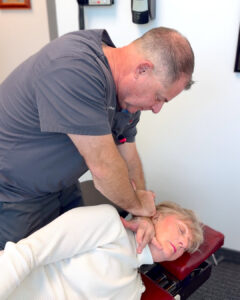
Dr. David Packer is the only board-certified NUCCA chiropractor in the Hampton Roads area, and one of a small number of NUCCA-certified doctors in the country. NUCCA is a chiropractic specialty focused on treating various spine-related conditions through the correction of the upper cervical spine, the area where your skull meets your atlas and axis vertebrae.
What sets NUCCA apart from general chiropractic care is the method of adjustment. There is no twisting, no rotational force, and no audible cracking. Every correction is calculated mathematically from a series of precision X-rays unique to each patient and delivered with gentle, sustained pressure.
Patients across Hampton Roads choose NUCCA when they want spinal correction that is precise, gentle, and based on individualized measurement rather than general manipulation.
What is NUCCA Chiropractic Care?
NUCCA stands for the National Upper Cervical Chiropractic Association. The technique has been in continuous use since 1966 and is governed by the NUCCA board, which sets standards for training, certification, and continuing education. The certification process requires extensive post-graduate training in biomechanical analysis, X-ray interpretation specific to upper cervical mechanics, and the precision correction technique itself.
Every NUCCA correction is calculated mathematically from a series of precision X-rays unique to each patient. There are over 10,000 different combinations of how the head and neck can be misaligned, and the correction is calculated specifically for the patient’s anatomy. No two patients receive the same correction.
The atlas is one of the most difficult areas of the spine to correct with precision. It is small, sits deep beneath the skull, and lacks the spinous anatomy that gives traditional chiropractic adjustments their mechanical leverage. It is also adjacent to the brainstem and vertebral arteries, where rotational force carries risk. NUCCA was developed specifically to address this region with low-force, mathematically-calculated correction rather than general manipulation.
NUCCA is one of the few chiropractic techniques with outcome research published in mainstream peer-reviewed medical journals, including a pilot study on migraine patients published in BioMed Research International.
Why the Upper Cervical Spine Matters
The atlas (C1) and axis (C2) vertebrae sit at the junction of your skull and your spine. This small region houses the brainstem and is the passageway for nerve signals between the brain and the rest of the body. It also influences blood flow to and from the brain, including cerebrospinal fluid dynamics.
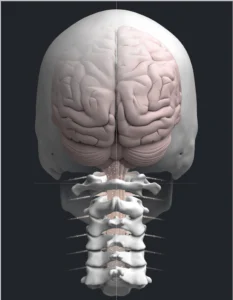
The head weighs 10 to 12 pounds and balances on a small joint surface at the top of the atlas. The body continuously adjusts the rest of the spine to keep the head level and the eyes oriented forward. When the atlas is even slightly offset, the body compensates everywhere below it. That cascading effect is why a misalignment at C1 can produce strain patterns, asymmetry, and pain throughout the entire spinal column.
When the upper cervical spine is misaligned, several systems can be affected.
Nerve irritation in the upper cervical region can produce pain signals that radiate into the head, face, and shoulders. The nerves that process pain in the upper neck share connections with the nerves that carry pain signals from the head and face, which is why upper cervical dysfunction can present as headache pain even when the neck itself doesn’t hurt.
Muscle tension patterns often respond to upper cervical alignment. Chronic tightness in the neck, shoulders, and muscles at the base of the skull is frequently a compensation for misalignment higher up.
Postural alignment throughout the spine is influenced by the head’s position on the atlas. When the head is offset, the body compensates in ways that can produce uneven hips, apparent leg length differences, and chronic strain patterns far from the neck.
A NUCCA evaluation considers the upper cervical spine even in patients whose symptoms appear unrelated to the neck. The mechanism is not always obvious, but the connection is anatomical.
NUCCA Corrects the Whole Spine, Not Just the Neck
A common misconception about NUCCA is that the “upper cervical” name means it only treats upper back and neck issues. The correction is applied at the upper cervical level, but the effect reaches the entire spine. NUCCA is regularly used to treat patients with low back pain, hip pain, sciatica, and other conditions far below the neck.
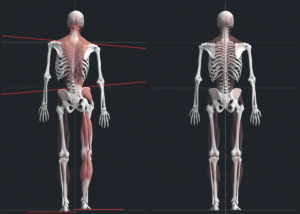
The position of the head determines how the rest of the spine is loaded. When the atlas sits properly beneath the skull, the cervical, thoracic, and lumbar regions settle into more balanced alignment. Uneven hips often even out. Apparent leg length differences resolve. Compensatory patterns that produced pain in the low back, hips, or pelvis can change. Sciatic nerve symptoms that came from the lower back compensating for misalignment above can improve as the spine rebalances.
NUCCA does not correct each level of the spine individually. It corrects the foundation, and the rest of the spine responds. This is why NUCCA can address conditions far below the neck even though the only place Dr. Packer touches is the upper cervical region.
How NUCCA Differs from Traditional Chiropractic
Most people picture chiropractic care as the spine being twisted, with audible cracking or popping sounds. That’s a description of high-velocity, low-amplitude manipulation, which is the most common technique used in general chiropractic.
NUCCA is fundamentally different in three ways.
1. Single adjustment point versus multiple. Traditional chiropractic adjustments typically apply rotational force at multiple points along the spine, producing joint cavitation (the audible popping). NUCCA corrects the entire spine by adjusting only one point: the atlas. Light, sustained pressure is applied to the side of the upper neck along a calculated vector. There is no twisting, no rotational force, and no audible release.
2. X-ray-calculated correction versus general impression. Traditional chiropractic adjustments are typically based on a general clinical impression of where the spine needs to move. NUCCA corrections are calculated from precision X-rays using specific mathematical formulas. The exact direction, depth, and pressure of the correction are determined by the doctor before the patient is adjusted.
3. Correction only when needed versus every visit. Traditional chiropractic adjustments are typically delivered at every appointment. NUCCA corrections are only performed when post-correction assessment shows that the previous correction is no longer holding. Some patients require only one correction. Others require periodic reassessment over weeks.
For patients who are nervous about harsh cracking or twisting, who have not responded to traditional chiropractic, or who have conditions where forceful adjustment isn’t safe, NUCCA offers a different path.
The NUCCA Evaluation Process
Before any correction is performed, Dr. Packer completes a structured evaluation to determine whether NUCCA is appropriate for your case and, if it is, exactly how your correction should be calculated.
Comprehensive history. Dr. Packer takes the time to understand your symptom pattern, any history of trauma, prior treatments, current medications, and what you have already tried. This clinical context guides the entire examination.
Postural assessment. A NUCCA evaluation includes a series of measurements: postural analysis, a leg length check while you lie on your back, and assessment of muscle tone patterns. These findings help confirm that an upper cervical misalignment is present before X-rays are taken.
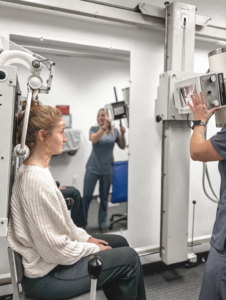
Precision cervical X-rays. Dr. Packer takes a series of cervical X-rays from specific angles, calculated for each patient’s anatomy. These are not standard screening X-rays. They are taken to the specific protocols required for NUCCA analysis.
Analysis of the misalignment. Dr. Packer measures and analyzes the X-rays using NUCCA protocol to determine the precise direction, magnitude, and angle of your misalignment. The result is the specific correction vector your anatomy requires.
How the NUCCA Correction Works
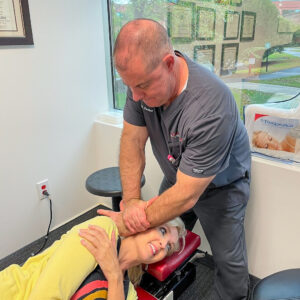
Once your X-rays are analyzed and the correction vector is calculated, the actual correction is straightforward.
You lie on your side on a specialized table. Dr. Packer positions his hand on a specific point along the side of your upper neck. He applies light, sustained pressure along the calculated vector. The correction takes seconds. There is no cracking, no popping, and no sudden movement.
Immediately afterward, Dr. Packer reassesses your postural alignment, leg length, and other indicators to confirm the correction held. If the indicators show that the correction worked, you are done for that visit. If something needs further refinement, the assessment guides the next step.
Follow-up appointments are scheduled to monitor whether the correction is holding. NUCCA does not require correction at every visit. The goal is for your body to stabilize in proper alignment with as few corrections as possible.
Supporting Your NUCCA Care
NUCCA corrections do not happen in isolation. The muscles, ligaments, and soft tissues around the spine are part of the same system, and targeted support helps the correction hold and the body heal.
At Precision Spinal Care, rehabilitation therapy, linear cervical traction, and massage therapy are integrated with NUCCA when indicated. Rehabilitation therapy strengthens the cervical musculature and improves postural control, helping the correction stabilize over time. Linear cervical traction applies a gentle pulling force along the length of the neck, decompressing the discs and joints and giving inflamed tissues space to recover. Massage therapy releases muscle tension and trigger points that might otherwise pull the body back out of alignment.
Whether you receive rehab therapy, traction, massage, or some combination alongside your NUCCA corrections depends on your individual findings. Dr. Packer determines the appropriate combination as part of your evaluation.
What to Expect at Your First Visit
Your first appointment is primarily diagnostic. Dr. Packer will spend time understanding your symptoms and medical history, complete the NUCCA assessment, take precision X-rays, and review the findings with you. If you are a NUCCA candidate, your first correction is typically performed at a follow-up appointment after Dr. Packer has completed the X-ray analysis.
Plan for the first visit to take up to two hours. Wear comfortable clothing.
Not every patient is a NUCCA candidate. If Dr. Packer’s evaluation finds that your condition is better suited for a different kind of treatment, he will tell you at the first visit and refer you directly. His fellowship rotations in neurosurgery, orthopedic surgery, neuroradiology, pain management, and emergency medicine give him a working understanding of how each specialty can help you if chiropractic care isn’t appropriate for your condition.
Conditions NUCCA May Help
NUCCA is most commonly used for conditions related to upper cervical dysfunction and the whole-spine compensations that follow. Common cases include chronic headaches and migraines, neck pain, low back pain, hip pain, sciatica, post-traumatic symptoms after auto accidents, vertigo, dizziness, and certain postural pain syndromes. Some patients with TMJ symptoms, trigeminal nerve pain, or chronic muscle tension also respond to NUCCA care.
Auto accident injuries. NUCCA offers a particular advantage for patients with post-traumatic symptoms after motor vehicle collisions. Whiplash and similar impact injuries often leave the cervical tissues inflamed and sensitive, and traditional high-velocity manipulation can aggravate the injured area. NUCCA’s light, mathematically-calculated correction addresses the underlying misalignment without adding rotational stress to an already-traumatized neck.
Each condition is evaluated individually, and Dr. Packer’s diagnostic process determines whether NUCCA is appropriate or whether a different approach is indicated.
Why Choose Dr. Packer for NUCCA Care

Board certification in NUCCA is held by only a small number of chiropractors worldwide. Dr. Packer is one of them, and he is the only board-certified NUCCA chiropractor in the Hampton Roads area.
His training extends beyond NUCCA itself. Dr. Packer is fellowship-trained in spinal biomechanics and trauma through the University at Buffalo Jacobs School of Medicine. His post-graduate credentials include MRI spine interpretation, spinal biomechanical engineering, orthopedic testing, and spinal trauma analysis. He is credentialed to read MRIs and make appropriate clinical decisions based on imaging findings.
His fellowship rotations provided interdisciplinary clinical exposure that informs how he evaluates each patient and decides whether NUCCA, another approach, or a referral is the right path. He also serves on the Board of Directors of the Chesapeake Regional Healthcare Foundation.
This combination of NUCCA board certification and fellowship training in spinal biomechanics and trauma is uncommon among chiropractors in Virginia.
Frequently Asked Questions About NUCCA
Schedule Your NUCCA Evaluation
If you have been told that chiropractic care isn’t for you, or if you have tried traditional adjustments without lasting results, a NUCCA evaluation may identify a mechanical cause that has been overlooked.
Schedule a NUCCA exam with Dr. David Packer at Precision Spinal Care today. Call (757) 382-5555 or book online.