
Find the Cause of Your Neck Pain, Not Just Temporary Relief
If you’re living with neck pain, you already know how it affects everything: your sleep, your ability to work, your time with family. At Precision Spinal Care in Chesapeake, Virginia, we take a different approach than most practices. Rather than simply treating your symptoms, we focus on identifying what’s actually causing your pain so you can find lasting relief.
Dr. David Packer is fellowship-trained in spinal biomechanics and trauma through SUNY Buffalo Jacobs School of Medicine and is the only board-certified NUCCA chiropractor in the Hampton Roads area. This combination of advanced diagnostic training and gentle, precision-based care allows us to identify problems that other providers may overlook and treat them without the cracking, twisting, or popping associated with traditional chiropractic adjustments.
Why Does My Neck Hurt?
The cervical spine (your neck) is the most vulnerable region of your entire spine. Your head weighs 10 to 14 pounds, roughly the weight of a bowling ball, and it sits on a small bone called the atlas that weighs only a few ounces. This unique anatomy makes the neck highly susceptible to injury and dysfunction.
Neck pain has many potential causes, and understanding which category your condition falls into is essential for choosing the right treatment.

Structural and Anatomical Causes
These include disc herniations, disc bulges, nerve root compression, spinal cord compression, bone spurs (osteophytes), stenosis, and degenerative changes. Structural problems often produce symptoms that extend beyond the neck itself, including radiating pain into the shoulder and arm or numbness and tingling in the hands.
Biomechanical Causes
Facet joint dysfunction, ligament injuries, soft tissue damage, altered joint motion, and muscle strain all fall into this category. The facet joints are the small joints at the back of your spine that let your neck bend and turn. In studies of people whose neck pain lasted more than three months after a car accident, these joints turned out to be the source of the pain in about half of them (Barnsley et al., Spine, 1995; Lord et al., Spine, 1996). That makes them one of the most common reasons neck pain sticks around after a crash.
Trauma-Related Causes
Motor vehicle accidents, sports injuries, falls, and direct blows to the head or neck can damage intervertebral discs, ligaments, and the soft tissues surrounding the spine. If you’ve been in an auto accident, it’s important to know that these injuries sometimes produce symptoms that don’t appear until weeks or months after the event.
Postural and Repetitive Stress
Years of poor posture, prolonged phone use, computer work, or sleeping in awkward positions can gradually produce neck pain and dysfunction. These causes are common in today’s work environments and often worsen over time without intervention.
Mechanical problems in the neck can cause more than local discomfort. They can be the source of radiating pain into the shoulder and arm, numbness and tingling in the hands, and headaches. They can also contribute to back pain through compensatory movement patterns. This is why accurate diagnosis matters so much. Treating the wrong structure will not resolve your symptoms.
Related reading: What Is a Herniated or Bulging Disc?
Our Diagnostic Approach: Finding the Real Problem
At Precision Spinal Care, we follow a systematic approach to diagnosis that ensures we identify the actual source of your neck pain before recommending any treatment.
Step 1: Comprehensive History
We take the time to understand your pain, your symptoms, when they started, what makes them better or worse, and any events that may have caused or contributed to your condition.
Step 2: Functional and Structural Examination
We perform orthopedic, neurological, and biomechanical assessments to clinically correlate your symptoms with objective findings. This includes range of motion testing, neurological screening, and evaluation of spinal mechanics.
Step 3: Diagnostic Imaging
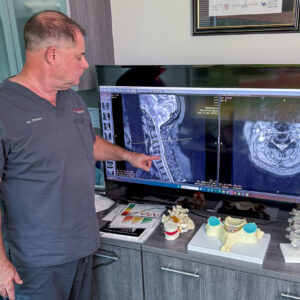
Based on what we find in your examination, we order the appropriate imaging, whether that’s cervical X-rays, flexion/extension X-ray analysis to assess ligament stability, or MRI to evaluate disc and soft tissue structures. We don’t guess. We confirm.
This approach matters because the cause of your neck pain determines the appropriate treatment. Disc problems require a different approach than facet joint dysfunction. Ligament instability requires different management than muscle strain. An accurate diagnosis is the foundation of effective care.
Dr. Packer holds post-graduate credentials in MRI spine interpretation, spinal biomechanical engineering, orthopedic testing, and spinal trauma through the University at Buffalo Jacobs School of Medicine. He is credentialed to read MRIs and make appropriate clinical decisions based on imaging findings.
The NUCCA Approach to Neck Pain
NUCCA stands for the National Upper Cervical Chiropractic Association. It represents a highly specialized approach to chiropractic care that focuses on the relationship between the head and the upper cervical spine, the area most commonly affected by neck pain and injury.
How NUCCA Differs from Traditional Chiropractic
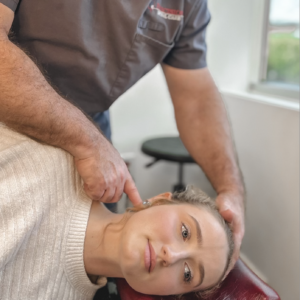
Unlike traditional chiropractic adjustments that involve twisting, rotating, or sudden movements of the spine, NUCCA corrections are gentle. You will feel only light pressure on the neck while Dr. Packer works. There is no cracking or popping.
For patients who have had negative experiences with traditional chiropractic care, or who are nervous about neck manipulation, NUCCA offers a gentle alternative that achieves results without force.
Precision-Based Corrections
NUCCA is precision-based. We take a series of X-rays that allow us to mathematically calculate your specific misalignment pattern. There are over 10,000 different combinations of how the head and neck can misalign, and your correction is calculated specifically for your anatomy, not a one-size-fits-all approach.
This precision means fewer adjustments are typically needed because we’re correcting the actual problem rather than repeatedly manipulating the spine. Many patients report that holding their correction allows their body to heal over time.
Related reading: How Does NUCCA or Light Force Chiropractic Work?
Neck Pain After a Car Accident
If your neck pain began after a motor vehicle accident, it’s important to understand that the forces involved in a collision can cause significant injury to the cervical spine, even when vehicle damage appears minimal.
How Whiplash Damages the Cervical Spine
Whiplash occurs when shearing forces are transmitted through the skull, neck, and upper back during impact. These forces can injure intervertebral discs, stretch the ligaments that hold your vertebrae together, and damage the soft tissues surrounding your spine.
Ligaments are the tough bands that hold your vertebrae in place. Laboratory testing on human spine specimens has shown something important about them. They can be stretched too far in a crash and stay loose afterward, even when they never tear all the way through and never show up as damaged on a standard scan. Ligaments stretched this way measure looser and weaker than normal ones (Ivancic et al., Clinical Biomechanics, 2008; Tominaga et al., BMC Musculoskeletal Disorders, 2006). Researchers believe that looseness is one reason neck pain can last long after a crash.
Why Ligament Injuries Cause Long-Term Pain
Ligaments have a relatively poor blood supply, and when they’re damaged, they often heal with scar tissue that is weaker, stiffer, and more sensitive than normal tissue. This explains why some patients continue to experience symptoms long after their accident. The underlying structural damage persists even after the initial inflammation resolves.
Why Standard Testing May Miss Your Injury
Negative X-rays and MRIs do not always exclude significant cervical injury. Many soft tissue injuries, ligament tears, and biomechanical problems do not show up on standard imaging. This is why our office utilizes flexion/extension X-ray analysis to assess for ligament instability and altered spinal mechanics that standard imaging may not reveal.
If you’ve been told “nothing is wrong” despite ongoing symptoms after an accident, a more thorough biomechanical evaluation may identify the source of your pain.
Related reading: What To Do After I’ve Been in a Car Accident
Comprehensive Care Under One Roof
Neck pain often requires more than one type of treatment. At Precision Spinal Care, we offer multiple services to address your condition from several angles.
Treatment Services
NUCCA Chiropractic Care – Gentle, precision-based corrections to restore proper alignment and function to the upper cervical spine.
Rehabilitation Therapy – Targeted rehab to strengthen supporting muscles, improve mobility, and reduce the risk of recurrence.
Massage Therapy – Our licensed massage therapist works with tight, painful muscles to complement your spinal care and improve soft tissue recovery.
Advanced Diagnostics – In-house cervical X-rays, flexion/extension studies for ligament instability assessment, computerized range of motion testing with surface EMG, and the ability to order MRI and CT scans when indicated.
Referral Network
When your condition requires care beyond what we provide, we refer directly to trusted neurologists, orthopedic surgeons, neurosurgeons, pain management physicians, and other specialists in the Hampton Roads area. Our goal is to get you the right care, whether that’s in our office or with a medical colleague.
Related reading: Treatment Options for Chronic Spine Related Pain
For Personal Injury Patients
If your neck pain is related to an auto accident or other injury case, we understand the importance of thorough documentation and appropriate care coordination.
Dr. Packer holds credentials in crash dynamics, accident reconstruction, and medical-legal documentation. He has served as an expert witness for auto injury patients in court and understands what is required to properly document and support your case.
We work with most insurance plans and offer medical lien options for personal injury cases, which means you may be able to receive treatment without upfront out-of-pocket costs while your case is pending.
Our documentation is optimized for insurance software and includes objective findings from computerized testing, imaging analysis, and standardized examination protocols. We communicate regularly with attorneys and case managers to ensure your care is coordinated and well-documented.
Related reading: What Is a Personal Injury Lien and Can I Use It to Pay for My Automobile Injury Related Healthcare?
Frequently Asked Questions About Neck Pain
Schedule Your Evaluation
Whether your neck pain is from a recent injury, a car accident, or has developed gradually over time, an accurate diagnosis is the first step toward finding relief.
Schedule an exam at Precision Spinal Care with Dr. Packer today. We’ll take the time to listen to your concerns, perform a thorough evaluation, and explain what we find in terms you can understand.